
Three Post‑Capitalist Architectures for the AI Age
Thoughts and theories about AI as a catalyst for social and economic changes.

AI isn’t just another productivity tool. It pressures the foundations of how we produce, distribute, and consume. If you buy that premise, you have to ask: what comes after capitalism? Here are three plausible post‑capitalist architectures drawn from the discussion: technofeudalism, an AI‑run Gosplan, and universal incorporation (turbo‑capitalism).
Quick refresher: what is an economic system?
Every system answers three questions:
What do we produce?
How do we produce it?
For whom?
Those answers depend on property regimes (private/public/collective), coordination mechanisms (markets, hierarchy, planning, networks), and resource allocation (prices, quotas, needs, or rights).
Why this time might actually be different
Over very long cycles, systems do flip. AI could be that trigger.
Tech is deflationary: better, faster, cheaper—pushing costs toward zero. That clashes with a capitalism that thrives with some inflation.
AI access is egalitarian: billionaire or broke, your ceiling with GPT‑class tools is roughly the same subscription tier.
Post‑labor dynamics: software agents and robots displace human labor across white‑ and blue‑collar work; many firms (SaaS, services, legal, finance, education) face extinction by automation.
Shrinking IQ premium: if everyone rents a “2,000 IQ” assistant for $20–$200/month, raw human variance matters less.
Potential mass unemployment and AGI: if machines outperform humans in most tasks, the industrial‑capitalist logic weakens.
Enter three scenarios.
Scenario 1: Technofeudalism
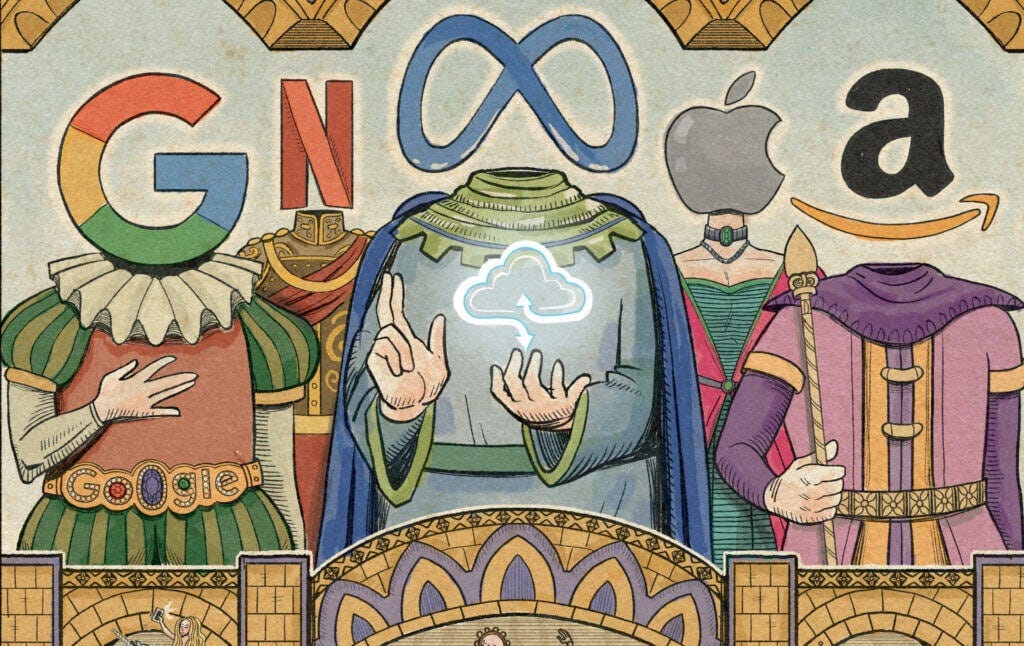
Popularized by Yanis Varoufakis, technofeudalism1 says we’re already sliding into a system where platforms replace markets.
How it works
Wealth flows not from competitive production, but from extracting rents via platform control (access, algorithms, data, network effects).
Think Amazon, Google, Meta, Apple, Microsoft; in China, Alibaba/Tencent; plus Palantir‑type infrastructure.
What changes vs capitalism
Power shifts from owning capital that produces goods to owning gates that control interactions.
Prices, visibility, and participation are mediated by opaque recommendation and policy engines, not free competition.
Producers and consumers behave like digital serfs on privately owned estates.
Role of the state
Vassal or accomplice: regulate in ways that protect local platform lords, depend on their infra/data, or even rely on them for core state functions.
So what
Platform risk becomes existential. Distribution sovereignty (owning direct customer relationships) matters more than ever.
Data, not factories, are the strategic asset. Effects of network > effects of scale.
Scenario 2: Gosplan AI

The Soviet Gosplan2 failed largely due to bad information and rigid planning. Replace human bureaucrats with real‑time data and an AI “cortex,” and the idea resurfaces.
From Gosplan to an AI planner
Ingest live data streams on production, logistics, inventories, energy, demand, health, environment—everything.
Allocate resources and set production dynamically, like a nervous system maintaining homeostasis.
How it would function
No prices needed; coordination via signals and optimization loops.
Fully robotic supply chains execute decisions without human bottlenecks.
Money, incentives, and control
Programmable CBDCs3 as the ledger of all transactions and the throttle for what can be bought, where, and when.
Universal basic income (adaptive by need) as the baseline; incentives tilt toward status/reputation scores (credit social‑style).
Upsides and risks
Potentially fewer chaotic cycles and less waste than market trial‑and‑error.
But everything hinges on who codes the system, how bias is handled, and whether society accepts deep programmability of life.
Scenario 3: Universal Incorporation (Turbo‑Capitalism)
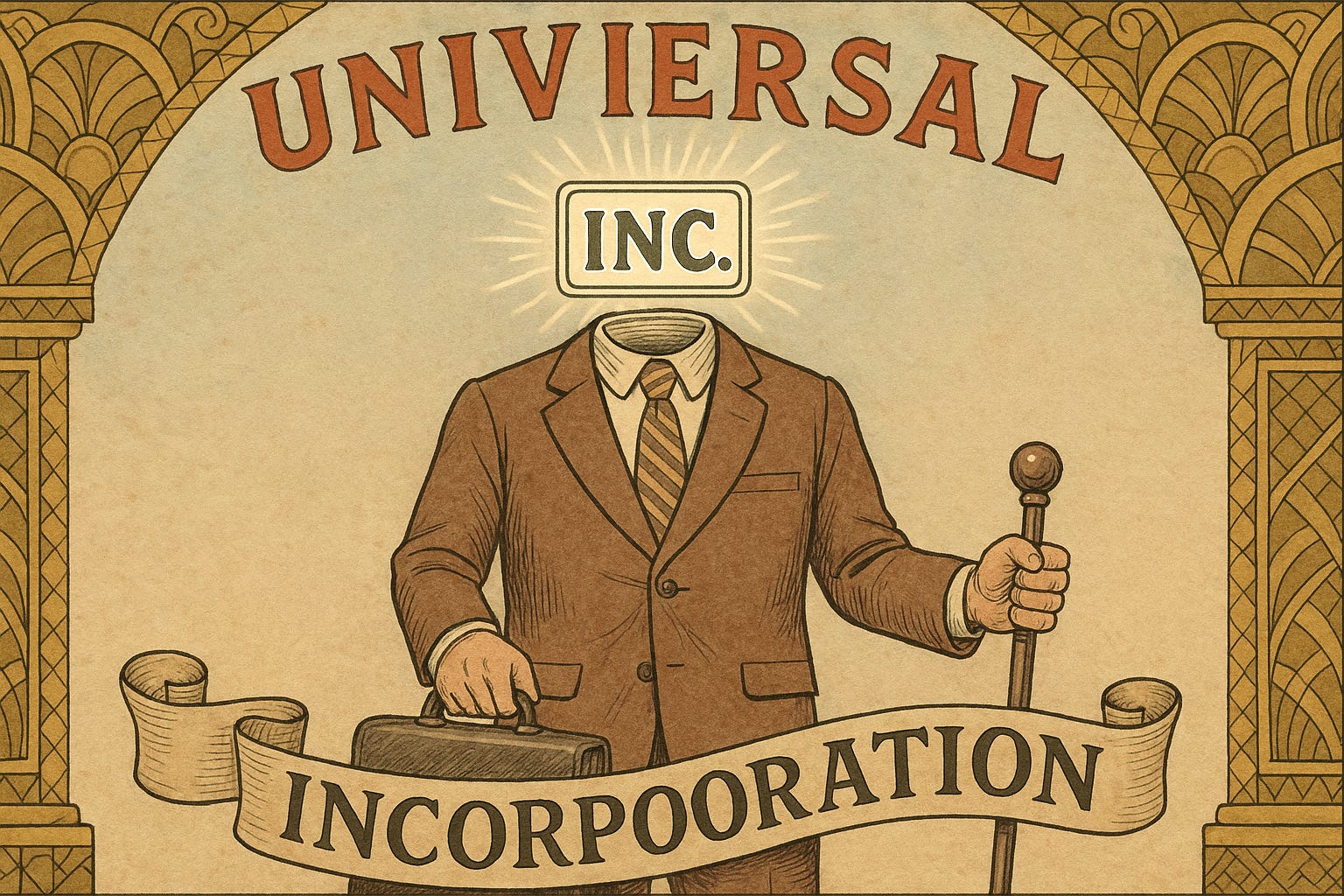
Inspired by The Unincorporated Man: push market logic to its extreme.
The setup
Every person is “incorporated” at birth (birth = IPO). You start with minority ownership in yourself; parents, the state, and investors hold the rest.
You sell equity in yourself to fund education, health, housing; you can buy back shares to regain autonomy—but rising prices make it hard.
Life under equity pressure
Shareholders can demand audits (even psychological/neurological), influence career/marriage decisions if they own enough voting power.
Daily life becomes performance under market scrutiny; your “ticker” drives status and optionality.
Money without a monopoly
No state monopoly on money: institutions issue their own currencies; value floats on trust and network power.
Transactional complexity explodes; systemic fragility rises with potential domino failures.
Why this feels familiar
Web3 (crypto) hinted at tokenized reputation, attention markets, and holders steering builders. It’s not the same, but rhymes.
What this means for tech and business
Hedge across architectures
Build for platform dependence and platform exit. Own first‑party data and distribution while leveraging platform reach.
Design for algorithmic allocation
If a Gosplan‑like allocator emerges, plug into real‑time data, traceability, and compliance by design.
Tokenization literacy
Even if we don’t reach full incorporation, expect more tradable reputation and programmable money. Prepare for portfolio‑like customers and stakeholders.
Automate the firm
Assume agentic software kills entire categories. Ship products that can operate under near‑zero marginal cost and human input.
Policy posture
Track the progress of CBDCs, digital ID, data localization, antitrust. Your strategy depends on which architecture your jurisdiction gravitates toward.
Human moat
If raw intelligence spreads via AI, moats come from trust, narrative, community, and hard‑to‑replicate networks.
Capitalism replaced feudalism when machines changed what was possible. AI and data might now replace industrial capitalism with something else—feudal, planned, or hyper‑market. For builders and operators, the job is to recognize the shift early, design for it, and keep your optionality.
Good luck, I guess…
Love this. With my limited imagination, I see ‘rented IQ’ as closer to the averaged cognition of the internet—likely above the human mean. The issue is that error rates compound across long action chains when you follow or rely on agentic outputs. As usage scales exponentially, that compounding becomes one of the biggest hurdles to the future you’re describing.
Over the longer term, I agree that data, compute, and the underlying electricity, critical minerals, and land become the defining assets of a post-capitalist era. The uncertainty is the speed of that shift. If traditional physical goods lose their scarcity, then scarcity—and therefore value—moves to the physical-constraint layer. That’s always been true historically, but it becomes far more explicit.
For someone average like myself, the practical beta in this transition may come from maximizing compounding inside countries where we can situate ourselves and where execution against those physical constraints is strongest—via relationships, access, and proximity to those critical assets.
It's interesting how you connect AI to feudalism, but is it really new?